
C.N.O. stands for Cute, Natural, and Organic!
Established 2013
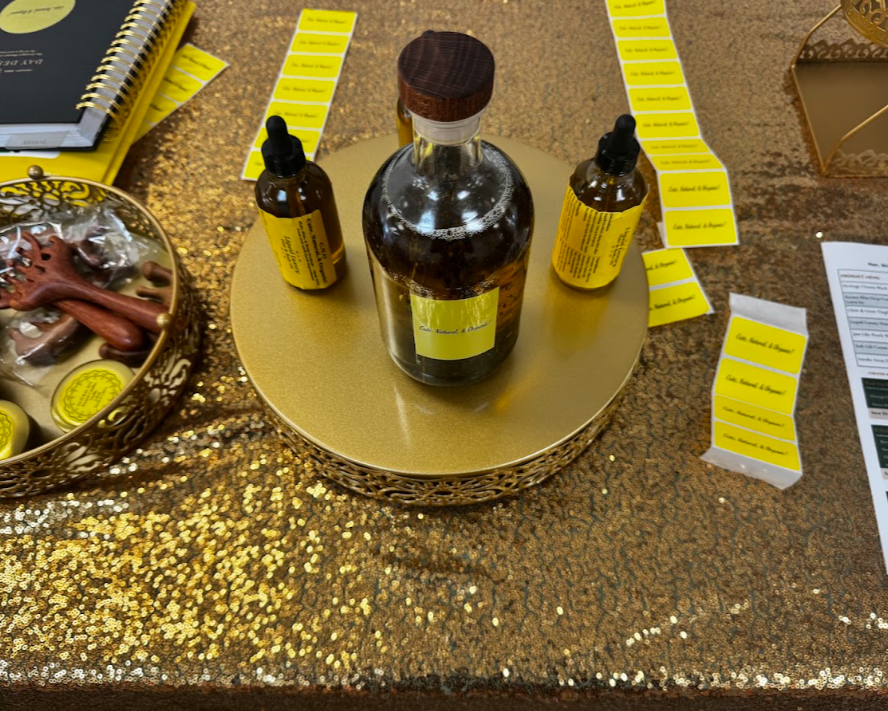
Born from Truth. Built on Nature. Made with Love.
Our Core Philosophy
100% Natural, No Exceptions: We don't rely on synthetic fillers, parabens, or misleading marketing. Every single ingredient is included for a specific, proven purpose.
Heritage-Driven Formulations: Our products draw on time-tested traditions from cultures that have cared for textured hair and skin for centuries—incorporating powerful elements like Batana oil from the Miskito people of Honduras, West African black soap, raw honey, and whipped shea butter.
Universal Care: While crafted with Afro-textured hair and sensitive skin in mind, our plant-based formulas provide deep moisture, nourishment, and health for any hair or skin type that needs pure care.
Health is Wealth. Joy is Wealth.
When you flip a C.N.O bottle over, you won't find unpronounceable chemicals—just clean, honest ingredients you can trust. Welcome to a simpler, more intentional routine for your hair, skin, and body.
The Origin Story
Born from Truth. Built on Nature. Made with Love.
How a curious child, a mother’s pain, and the wisdom of the Earth created a wellness movement the world was waiting for.
Part I - The World She Was Born Into
“Our grandmothers tried to tell them. They already knew.”
— The unspoken truth passed down through generations of Black women
C.N.O was founded by Rinella, born in 2001 into a generation where the chemical perm was still a rite of passage — a ritual so normalized in Black households that questioning it felt like questioning tradition itself. Relaxers and texturizers were everywhere: on bathroom shelves, in beauty supply aisles, applied in kitchens and salons to daughters as young as six and seven years old.
But the grandmothers knew. They had seen what those chemicals did over time. They warned their daughters. Some listened. Many didn’t — because the beauty industry was loud, and the pressure to have “manageable” hair in a world that had not yet learned to see natural Black hair as professional, beautiful, or acceptable was louder still.
The pressure was cultural. It was institutional. And it was, as science has since confirmed, deeply harmful to the bodies of the women who bore it.
What the Science Now Confirms
The health risks of chemical hair relaxers are no longer speculative. They are documented in peer-reviewed research published by the National Institutes of Health, Boston University, and leading cancer research institutions. The findings are serious; the populations most affected are Black women, and the industry largely said nothing for decades.
The Research on Relaxers & Cancer Risk
A 2022 NIH study tracking more than 33,000 women over 11 years found that women who used chemical hair straighteners more than four times per year were more than twice as likely to develop uterine cancer. (National Institutes of Health, Sister Study, 2022)
The Black Women’s Health Study at Boston University found that postmenopausal Black women who used chemical hair relaxers more than twice a year, or for more than five years, had a greater than 50% increased risk of uterine cancer. (BWHS, Boston University, published in JNCI, 2023)
A 2021 study published in Carcinogenesis found that women who used hair straighteners more than four times per year had a 50% increased risk of ovarian cancer. (National Institutes of Health, Sister Study) Newer NIH research from the Sister Study cohort has expanded the findings to link hair straightener use to elevated risk of pancreatic cancer, thyroid cancer, and non-Hodgkin’s lymphoma. (Dermatology Times / NIH Sister Study, 2026)
Researchers at the Journal of Exposure Science found high concentrations of phthalates and parabens — known endocrine-disrupting chemicals (EDCs) — in the urine of women who regularly use chemical hair relaxers, suggesting systemic absorption through the scalp. (James-Todd et al., 2021)
Chemical relaxers contain formaldehyde, a known human carcinogen, which damages DNA in white blood cells and has been linked to myeloid leukemia. They also contain phthalates, parabens, bisphenol A (BPA), lye (sodium hydroxide), and cyclosiloxanes — many of which are endocrine disruptors that mimic or block estrogen in the body. (ScienceDirect, 2023)
These are not fringe claims. They are the findings of the National Institutes of Health, Boston University, and peer-reviewed oncology and environmental health journals. And they describe a product disproportionately marketed to and used by Black women and girls — often beginning in childhood.
The scalp burns. The bald spots. The chemical-induced hair loss that left permanent marks not just on hairlines, but on the confidence of an entire generation of Black women who were made to feel their natural hair was a problem to be solved. The grandmothers were right. And now the science agrees with them.
Part II - Her Mother’s Turning Point
“She was so hurt that she never permed her hair again. And in that pain, something beautiful began.”
— On watching her mother transform
When Rinella was twelve years old, her mother was going through something quiet and difficult. She had been getting relaxers for years — like so many Black women of her generation, it was simply what you did. Then one day, a DIY box kit from the beauty supply store went wrong. The relaxer burned her scalp. It burned her hair. And it left damage that took time, tears, and patience to recover from.
She stopped. She never permed her hair again.
What followed was the experience that millions of Black women know: the transition. Watching the straight, chemically processed ends grow out while new, coily, natural hair pushed through from the roots. Two textures. Two identities almost. Learning to love something she had been conditioned to see as difficult, unruly, and “unprofessional.” Learning to care for hair she had never been taught to care for naturally.
For a curious, observant twelve-year-old watching her mother navigate this transition, the question that followed was simple and profound:
“Why would you have natural hair — and then put chemicals on it?”
— Rinella, age 12
It was not a rhetorical question. It was a real one. And when she went to find the answer — when she looked up what products were actually made for natural hair — she found shelves full of items marketed to the natural hair community that were, ingredient by ingredient, still full of synthetic chemicals, artificial dyes, silicones, and fillers.
The packaging had changed. The marketing language had changed. But the chemicals hadn’t.
Part III - The Curious Child
“If you can’t eat it, or if eating it would harm you — why are you putting it on your body?”
— The question that started everything
Rinella had always been curious about how things were made. She loved nature, loved planting things, loved watching and understanding processes — the way ingredients combined, the way chemistry produced outcomes, the way the natural world offered solutions that humans had been borrowing from for centuries. As a child, she would watch “How It’s Made” and feel that quiet thrill of understanding.
So when she saw what was in most natural hair products, she did what curious minds do: she started researching. She started asking. And the more she learned, the clearer the answer became.
The principle she landed on at twelve years old is the same one that drives C.N.O today:
If you cannot eat it — or if eating it would harm you — you should not be putting it on your external body, your hair, or your skin.
Your skin is your largest organ. It absorbs what you apply to it. Everything that goes on your body eventually goes into your body.
She began to research natural ingredients. Not the ingredients in products — the actual raw ingredients. She discovered a world that had been there all along: the oils and butters and plant actives used for generations by cultures across Africa, the Caribbean, South America, the Middle East, and beyond. Ingredients that were not trending — they were ancient. Proven. Deeply rooted in the knowledge of people who had always understood that the Earth provided what the body needed.
The Ingredients That Changed Everything
As a child with Afro-Caribbean heritage — with roots in Haiti, a country that has long produced its own black castor oil, prized for generations as a natural treatment for hair growth, scalp health, and skin nourishment — Rinella felt a personal connection to what she was discovering. These were not exotic commodities. They were heritage.
• Haitian Black Castor Oil — produced in Haiti, known for stimulating scalp circulation, strengthening hair from the root, and promoting growth. A cornerstone of Caribbean natural hair care for generations.
• Chebe Powder — originating from the women of the Basara Arab tribe in Chad, Central Africa, chebe is a plant-based powder traditionally used to retain hair length and protect against breakage. It has been used for centuries and gained global attention as evidence of its efficacy became undeniable.
• African Shea Butter — produced across West and East Africa, shea is one of the most versatile natural emollients in existence, used on hair and skin for centuries for deep moisture, anti-inflammatory benefits, and protective conditioning.
• Batana Oil — native to the Miskito people of Honduras and Nicaragua, known as the “miracle oil” of La Mosquitia. Rich in tocopherols, oleic acid, and beta-carotene, batana is used traditionally to restore damaged hair, promote growth, and deeply condition both hair and skin.
• Aloe Vera, Raw Honey, Flaxseed — used across countless cultures for their hydrating, anti-inflammatory, and antimicrobial properties. Nature’s original hair and skin care.
What struck Rinella was not just how effective these ingredients were — it was how they connected to culture, community, and the earth itself. These were not invented in a lab. They were cultivated by people who understood the land, who passed that knowledge from generation to generation, who never needed a marketing campaign to tell them these things worked.
She wanted to honor that. Not appropriate it — honor it. By sourcing ethically, formulating thoughtfully, and telling the truth about where these ingredients came from and why they matter.
Part IV - The Family That Made Her
“My grandfather always said he was building wealth for us. He meant every kind of wealth — knowledge, business, community, legacy. I didn’t know it then, but he was describing exactly what C.N.O would become.”
— Rinella, on her grandfather’s legacy
Rinella’s mother never permed her daughter’s hair. She was happy about that — and quietly grieved that she had not made the same choice for herself sooner. That grief was part of the story too. Not just the burn, not just the damage, but the specific ache of a mother who had been warned, who had not listened in time, and who made sure her daughter would never carry that same regret.
Growing up, Rinella had her hair done once or twice a month — professionally cared for, lovingly maintained. Then, as her curiosity about natural ingredients deepened and money got tighter for her mother raising her as a single parent, something shifted. Rinella came to her mother with a list: natural ingredients she wanted to source, things she had researched, a vision forming in her mind about what she could make herself.
Her mother said yes. She believed in her daughter. She helped her buy the ingredients and the materials, even when resources were stretched — because she recognized what was happening: her child was not just making products. She was finding her purpose.
The Circle of Trust
Every great product needs a testing ground. Rinella’s was her family. She was her own first test subject — mixing, applying, observing, adjusting. Then her mother. Then her cousins and her auntie. Then her friends. A small, trusted, honest circle of people who told her the truth about what worked and what didn’t, who let her try things on their hair and skin, and who showed up for her the way families and chosen families do — with full investment in her success.
That circle was not an accident. It was the fruit of how she was raised — in a household and an extended family where community, support, and collective investment in one another’s growth were simply the way things were done.
An Entrepreneurial Bloodline
Rinella did not arrive at entrepreneurship from nowhere. She came from a family of builders.
Her grandfather built a recycling company from the ground up — a Black man from Haiti, in America, who understood long before it became a trend, that sustainability was a business, a community responsibility, and a form of legacy. He ran it with discipline and pride. And he was vocal, always, about what he believed his family needed above all else: education and ownership. He looked at his granddaughter — a beautiful Black girl growing up in a world that would not always see her clearly — and told her plainly:
“Get educated. Especially as a beautiful Black woman. I am building wealth for us.”
— Rinella’s grandfather
Those words did not fall on passive ears. They were absorbed into the person Rinella was already becoming — a young woman who would go on to be a first-generation student who earned her MPH in Biostatistics, who would research health equity , who would analyze federal health policy and community health data, and who would build a business rooted in the exact definition of wealth her grandfather had described: not just financial, but educational, communal, and generational.
Her Mother’s Table
Her mother was an entrepreneur too. She built a catering business inspired by her own mother’s cooking — Rinella’s grandmother, whose Haitian recipes were the kind that filled rooms with memory and fed people in the deepest sense of the word. The catering business was a family operation: everyone came together to cook, to serve, to show up. They fed Haitian balls — the elegant, culturally rich formal events that are a cornerstone of Haitian-American community life. Birthday parties. Graduations. Celebrations of every kind.
What Rinella absorbed in those kitchens and at those serving tables was more than food. It was a model of how business could be done: with your family beside you, with cultural pride baked into every dish, with the community as your client and your purpose at the same time. You were not just running a catering company. You were feeding your people. You were honoring your grandmother every time you set the table.
C.N.O carries that same DNA. It is not a transaction. It is an act of care. It is a way of feeding your people — not with food, but with the knowledge, the products, and the philosophy that says: your body deserves what is real. You deserve to know what you are putting on yourself.
You deserve to be nourished by the Earth and by someone who made this with their hands, with love, thinking of you.
Rooted in Two Worlds, Building a Third
Rinella grew up in an African American and Haitian Caribbean household — two cultures with deep, overlapping traditions of natural healing, communal care, and hard-won resilience. From the African American side: a legacy of turning ingenuity into survival, of building community institutions from nothing, of understanding that knowledge and ownership are the only things that cannot be taken from you. From the Haitian Caribbean side: a legacy of the world’s first and only successful slave revolution, a people who grow their own castor oil, cook with their own herbs, and have always known how to care for themselves with what the land provides.
C.N.O lives at the intersection of those two worlds. It is Black American entrepreneurship and Haitian natural wisdom meeting in a jar of handmade, intentional, lovingly crafted product. It is a granddaughter honoring her grandfather’s recycling company, her grandmother’s recipes, her mother’s courage to stop using chemicals on her hair — and building something of her own that carries all of them forward.
Part V - The Sandwich Bag Era (Continued)
“I thought I was in trouble. She was walking toward me in the hallway with purpose. And then she asked what I put in that oil.”
— On the day everything changed
At twelve years old, in sixth grade, Rinella began making her own oil blends and learned to create and publish the first version of the CNO website. Simple, intentional mixtures of the natural ingredients she had been researching — oils chosen for their specific benefits to the scalp and hair shaft, combined with a purpose and a philosophy already forming: multi-use, natural, effective, honest.
She packaged them in plastic sandwich bags. She sold them to her friends for $2 to $3.
One product in particular stood out early: what would eventually become the Glow & Grow Oil — a tingling scalp oil formulated to stimulate circulation, nourish the follicle, protect against split ends, and encourage growth. A multi-use product that could be used on both hair and skin. Consolidated care. Minimalist. Effective.
And then one day, a friend’s mother appeared in the school hallway. Walking toward her with intention. Rinella’s first instinct was that she was in trouble.
She wasn’t.
The woman asked: “What did you put in that product you made? My child’s hair is growing faster. I had to get her perm touched up sooner than usual.”
She was still getting perms — like many women in that community were at the time — but she was using Rinella’s oil as a nurturing treatment, a hot oil treatment, a moisturizer, a way of taking care of the hair she had even as it existed within a system that was still slowly changing.
Rinella told her exactly what was in it. Every ingredient. No mystery, no proprietary secret from a twelve-year-old — just honesty. The woman asked for more. Her friend paid her the next day.
“I loved that I was able to create something that benefited others. That helped them love themselves. That prioritized their health. I was twelve, and I already knew this was what I was supposed to do.”
— Rinella, founder of C.N.O
That moment in the hallway was the first sale. The first product testimonial. The first proof of concept. And the first seed of what C.N.O would grow into: a brand built on the belief that educating people and giving them something real is more powerful than any marketing campaign.
Part VI - Why C.N.O Exists
“You don’t want temporary care or temporary looks. You want something that heals you over time, consistently, because it respects your body the way you deserve to be respected.”
— C.N.O Brand Philosophy
C.N.O exists because the beauty industry made a calculation that profit mattered more than safety, and that Black women’s bodies were an acceptable margin of risk.
It exists because grandmothers warned their daughters and were not always heard, but were always right.
It exists because a mother burned her scalp and decided she was done, and in doing so gave her daughter a front-row seat to what reclaiming your natural self actually looks like: confusing at first, then liberating, then beautiful.
It exists because a twelve-year-old in middle school sat with a question — why would you have natural hair and put chemicals on it? — and refused to let it go unanswered.
It exists because cultures across the Caribbean, Africa, and the world have held the answers all along — in their oils, their butters, their plants, their practices — and those answers deserve to be honored, not extracted and erased.
What C.N.O Is NOT
• C.N.O is not a temporary fix. Chemicals that make your hair look straight today while quietly disrupting your hormones are a temporary fix. C.N.O is consistent, cumulative care that builds real health over time.
• C.N.O is not a trend. Natural ingredients are not a wellness trend — they are the original. C.N.O honors that lineage.
• C.N.O is not chemical dependency. Many conventional hair and skin products are formulated to create the very problems they claim to solve: stripping natural oils with sulfates so you need the moisturizer, drying out the scalp so you need the serum. C.N.O breaks that cycle.
• C.N.O is not complicated. Natural care should not require a chemistry degree or a $400+ routine. C.N.O makes it simple, accessible, and consolidated — multi-use products that honor your time and your body.
What C.N.O IS
• Handmade, every product, every time — because mass production trades quality for volume and C.N.O refuses that trade.
• Transparent — every ingredient listed, sourced with intention, explained with honesty.
• Rooted in cultural heritage — honoring the Haitian, African, Caribbean, and Indigenous knowledge embedded in the ingredients we use.
• Built on science — natural does not mean unresearched. Every C.N.O formula is built on an understanding of ingredient chemistry, pH balance, emulsification, and preservation.
• A wellness movement, not just a product line — because Rinella has always believed that educating and elevating her community is the actual work.
Part VII - The Bigger Vision: Protect Black Joy
C.N.O is not the end of Rinella’s vision. It is the beginning of it.
Alongside C.N.O, she is developing a foundation — Protect Black Joy — rooted in the same belief that has driven everything from her early oil mixes to her MPH in Biostatistics, her public health research, and her decade of community investment: that the health, joy, self-worth, and wellness of Black people is worth protecting, investing in, and fighting for.
Health equity. Mental health. Maternal health. The right to know what is in the products on your shelves. The right to understand your body. The right to choose natural care without it being a luxury item. The right to love your hair, your skin, your natural self, without a multibillion-dollar industry profiting from your insecurity.
C.N.O funds that vision. And that vision gives C.N.O its soul.
“I’ve always held my business close to my heart. I always enjoyed educating and giving back to my community. Elevating people to general joy — to real wealth. Health is wealth. Joy is wealth. Knowing yourself and choosing yourself — that is wealth.”
— Rinella, Founder
C.N.O & Protect Black Joy Foundation
Scientific References & Citations
The following peer-reviewed studies and institutional research support the health claims referenced in C.N.O’s origin story and wellness campaign:
1. Chang, C.J., et al. (2022). Use of Straighteners and Other Hair Products and Incident Uterine Cancer. Journal of the National Cancer Institute. National Institutes of Health / NIH Sister Study. doi: 10.1093/jnci/djac165
2. Bertrand, K.A., et al. (2023). Hair relaxer use and risk of uterine cancer in the Black Women’s Health Study. Journal of the National Cancer Institute. Boston University Black Women’s Health Study. PubMed PMID: 37821068
3. Wentzensen, N. et al. (2021). Hair Straighteners and Ovarian Cancer Risk. Carcinogenesis. National Institutes of Health Sister Study Cohort.
4. Ose, J. et al. (2026). Use of hair straighteners and chemical relaxers and incidence of non-reproductive cancers. PMC / National Cancer Institute. PMC article: PMC12487841
5. James-Todd, T., et al. (2021). Hormonal activity in commonly used Black hair care products: evaluating hormone disruption as a plausible contribution to health disparities. Journal of Exposure Science & Environmental Epidemiology, 31, 476–486.
6. Helm, J.S., et al. (2018). Measurement of endocrine-disrupting and asthma-associated chemicals in hair products used by Black women. Environmental Research, 165, 448–458.
7. Schildroth, S. et al. (2024). Hair product use and urinary biomarker concentrations of non-persistent endocrine-disrupting chemicals among reproductive-aged Black women. Chemosphere, 361, 142442. 8. Dermatology Times. (January 2026). Hair Relaxers Tied to Higher Risk of Non-Reproductive Cancers, According to NIH Study. dermatologytimes.com
9. BreastCancer.org. (2022). Untangling the Link Between Hair Relaxers and Breast Cancer Risk in Black Women. breastcancer.org
Cute Natural Organic (C.N.O)
Born from Truth. Built on Nature. Made with Love.
Health is Wealth. Joy is Wealth. You are Worth It.